
Edible Landscaping
Edible is Beautiful.
Grow food in a landscape that works better, not harder
Most people think growing food means setting aside space for a garden. Edible landscaping takes a different approach. Instead of separating beauty and productivity, it brings them together. The goal is not to turn your yard into a vegetable garden, but to make your landscape more useful, more resilient, and just as attractive, often more so.
You can download Edible Landscape Plants for the NC Piedmont, a PDF handout with a cross-referenced list of edible plants.
Start Where You Are
Getting started does not require a complete redesign.
 Most edible landscapes begin with small, intentional changes.
You can replace something you already have, add something new, or make better use of the space you already have.
These simple steps are often enough to change how you see your entire landscape.
Replace One Plant, Change the Function
The easiest way to begin is to change what a space does, not how it looks.
Many ornamental plants provide structure and visual appeal, but no additional function. By replacing just one of those plants with something edible, you keep the design intact while making the space more useful.
In most cases, the role of the plant stays the same. A hedge still defines a boundary. A border still softens an edge. A focal plant still draws attention. What changes is what the plant contributes.
Common swaps that work well:
- Boxwood or similar low shrubs → dwarf blueberry
- Seasonal annual color → basil, parsley, chard, or leafy greens
- Decorative edging plants → strawberries or low-growing herbs
- Flowering ornamentals → edible perennials with visual bloom value
Why this works:
- You are not redesigning the landscape
- You are preserving the structure and layout
- You are changing the function of the plant
Key idea: You are not adding complexity. You are changing function.
Add One Plant, Change How You See the Space
If replacing feels like too much, start by adding.
A single edible plant, placed intentionally, can shift how you think about your entire landscape. You do not need a full plan. You need a starting point.
Adding one plant introduces a new way of seeing. Once it is there, you begin to notice other opportunities. Spaces that once felt fixed begin to feel flexible.
Simple additions that work well:
- One blueberry shrub in an existing bed
- A small grouping of herbs near the kitchen
- A container plant at an entryway or patio
- A single edible focal plant placed where it will be seen often
Why this works:
- It creates change without disruption
- It builds familiarity and confidence
- It shifts how you evaluate the rest of the landscape
Key idea: One addition is often enough to change how you see everything else.
Rethink Your Foundation Plantings
Foundation plantings are one of the easiest places to begin.
Most homes already have a set of plants around the base of the house. These spaces are visible, established, and regularly maintained, which makes them ideal for introducing edible plants without disrupting the overall landscape.
Instead of treating foundation plantings as purely decorative, you can begin to see them as productive and functional spaces. The structure stays the same. The purpose expands.
Over time, this way of thinking naturally extends beyond the house. What starts as foundation planting begins to influence how you use nearby borders, transitions, and other connected spaces.
Foundation areas that work well:
- Around the base of the house → blueberries, figs, rosemary, compact shrubs
- Front-facing beds → herbs mixed with ornamentals
- Entry-adjacent plantings → high-use edible plants
- Connected borders and transitions → low herbs, strawberries, greens
Why this works:
- These areas are already designed and maintained
- They are high-visibility, which encourages use
- They sit close to the home, making harvesting convenient
- They create a natural bridge between ornamental and edible design
Key idea: Start with what is already established. Let it become more useful.
Start Small and Let It Grow
You do not need to get everything right at once.
Edible landscaping works best when it develops over time. Start with one space, make a few changes, and observe what happens. The landscape will begin to guide your next decisions.
Small changes reduce risk and increase learning. Instead of committing to a full redesign, you allow the system to evolve based on what works for you.
A simple way to begin:
- Choose one bed or visible area
- Make two or three intentional changes
- Observe how the space looks and functions
- Let the next step emerge naturally
Key idea: Start with one space. Let it teach you what to do next.
Make It Look Good
Design edible landscapes that are as visually appealing as they are productive.
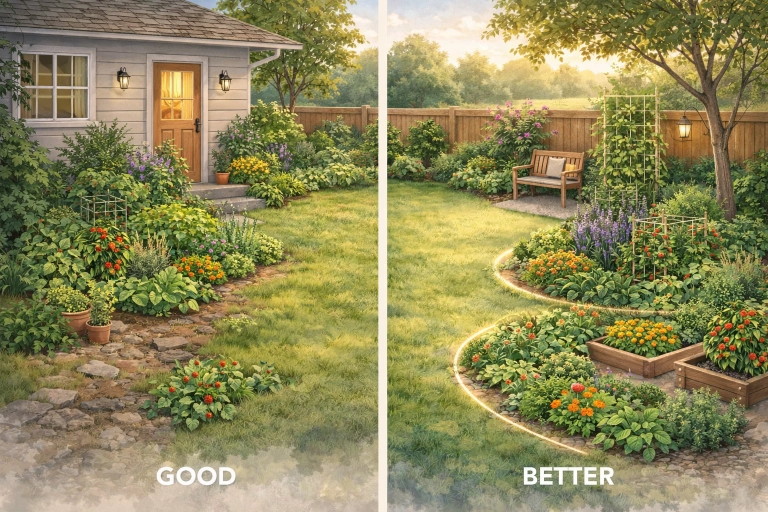 A well-designed edible landscape does not look like a vegetable garden placed in the yard. It looks intentional, balanced, and inviting. The difference comes from how plants are combined, arranged, and repeated throughout the space. By focusing on structure, layering, and visual rhythm, you can create a landscape that feels cohesive while also producing food.
This builds on where you started. Now the goal is to make those choices feel intentional and visually connected.
Blend Edible and Ornamental Plants into One Cohesive Design
Do not separate food from beauty. Combine them intentionally.
Most people think edible plants belong in a separate space, often hidden away in a garden bed. That separation is what makes edible landscapes feel out of place. The goal instead is to integrate edible plants directly into the existing design, so they feel natural rather than added.
Blending works when edible plants are treated the same way as ornamentals. That means paying attention to color, texture, height, and seasonal interest, not just whether the plant produces food. When these elements are aligned, the landscape reads as a single, unified space.
Instead of thinking in categories like vegetables, herbs, or flowers, begin to think in roles:
- Structure → shrubs and larger plants that define space
- Filler → mid-height plants that create density
- Edge → low-growing plants that soften boundaries
- Accent → plants that draw attention or provide contrast
Edible plants can fill each of these roles just as effectively as ornamental ones.
Examples of blending that work well:
- Blueberries used as foundation shrubs instead of purely ornamental bushes
- Herbs like rosemary, sage, and thyme are used as structural or border plants
- Leafy greens like kale or chard are used as seasonal color and texture
- Strawberries used as a living groundcover along edges
Blending also improves how the landscape is experienced. Instead of a space that looks good in one season and is ignored in another, you create a landscape that is visually interesting and actively used year-round.
The result is not a compromise between beauty and function. It is a landscape where both are working together.
Key idea: Do not separate food from beauty. Design them together.
Use Layers to Create Depth, Structure, and Visual Interest
Arrange plants in layers so the landscape feels full, natural, and intentional.
A landscape that looks good is rarely flat. It has depth. It has movement. It has a sense that plants belong where they are. This comes from layering, which is the deliberate use of height, spacing, and plant form to create a visually rich space.
Layering is what separates a collection of plants from a designed landscape.
Think in vertical structure rather than individual plants:
- Back layer → taller plants that provide structure and backdrop
- Middle layer → plants that create fullness and continuity
- Front layer → low-growing plants that define the edge and soften transitions
Each layer supports the others. Without this structure, even good plant choices can look scattered or unfinished.
Edible plants work naturally within this system:
- Taller crops like tomatoes, okra, or fruiting shrubs → back layer
- Mid-height herbs and greens → middle layer
- Low herbs, strawberries, and thyme → front layer
Layering also improves how the space is experienced over time. As plants grow, fill in, and change with the seasons, the landscape maintains a sense of continuity and balance rather than becoming uneven or empty in places.
This is especially important with edible plants, which often change faster than ornamentals. Layering helps absorb that change and keeps the design stable.
Why this works:
- It creates a natural visual hierarchy
- It reduces the appearance of gaps or bare soil
- It allows edible plants to feel integrated rather than temporary
- It supports both aesthetic and functional use of the space
Key idea: Layer plants by height and role so the space feels complete rather than scattered.
Use Repetition to Create Rhythm and Visual Cohesion
Repeat plants and patterns so the landscape feels organized and intentional.
One of the most common reasons landscapes look disorganized is that every plant is different. Even when the plants are individually attractive, the overall space can feel scattered or busy. Repetition solves this problem by creating visual rhythm and consistency.
When the same plant, color, or form appears in multiple places, the eye begins to recognize a pattern. That pattern makes the landscape feel planned rather than random.
Repetition does not mean uniformity. It means intentional reuse of key elements:
- Repeat the same plant in multiple locations
- Repeat similar shapes or textures across a bed
- Repeat color themes to unify different areas
- Repeat structural plants to anchor the design
Edible plants are especially effective for repetition:
- Blueberries repeated along a foundation or border
- Herbs like basil or parsley are used in multiple beds or containers
- Leafy greens planted in small groups throughout a space
- Strawberries repeated along edges or pathways
Repetition also helps tie together spaces that might otherwise feel separate. A plant that appears near the front entry and again along a walkway creates a visual connection between those areas.
This is how a landscape begins to feel cohesive, even if it evolves over time.
Why this works:
- It creates a sense of order and predictability
- It reduces visual clutter
- It helps guide the eye through the landscape
- It makes the design feel intentional, even when it is simple
Key idea: Repeat what works so the landscape feels connected rather than random.
Use Anchor Plants to Ground the Design and Create Focus
Give the eye a place to land.
Even a well-layered and repeated landscape can feel unsettled if nothing stands out. Anchor plants solve this by creating visual focus and stability. They act as reference points that help organize everything around them.
An anchor is not just any plant. It is a plant that has enough presence, size, or character to hold the space visually.
Think of anchor plants as the structure that everything else relates to:
- They define important areas
- They create focal points
- They provide a sense of permanence
- They help smaller plants feel connected
Without anchors, a landscape can feel like a collection of parts. With them, it feels like a designed system.
Edible plants can serve as strong anchors:
- A well-placed fig tree or fruit tree near an entry or patio
- A grouping of blueberry shrubs used as a dominant structural element
- A large rosemary or herb mass that holds a corner or transition
- A prominent container planting that draws attention
Anchors also help guide how the space is experienced. They draw attention first, then allow the eye to move outward into the surrounding layers and repeated elements.
This creates a landscape that feels intentional, balanced, and easy to understand.
Why this works:
- It provides a clear visual starting point
- It reduces the feeling of randomness
- It strengthens the overall structure of the design
- It helps unify surrounding plants and spaces
Key idea: Anchor the space so everything else has a place to belong.
Make It Work
Design a landscape that functions as well as it looks, reducing effort while increasing yield and resilience.

A well-designed edible landscape does more than grow food. It reduces unnecessary work, uses resources wisely, and aligns with how plants actually grow and interact. When the system works, you spend less time fixing problems and more time enjoying results.
This is where design shifts from appearance to performance. Every choice, from plant placement to irrigation, either adds friction or removes it.
Once a landscape looks cohesive, the next step is to make it function with less effort.
Put Every Plant Where It Can Succeed
Design begins with placement, because where a plant lives determines how well it performs with minimal intervention
A productive edible landscape is not random. It is an intentional placement aligned with light, water, access, and growth behavior. When plants are placed correctly from the beginning, they require less correction later. Poor placement creates ongoing friction, while good placement creates momentum.
Start by observing your space, not forcing it. Notice sun patterns throughout the day, areas that stay wet or dry, and how you naturally move through the landscape. These patterns should guide your decisions more than any fixed planting plan.
- Match plants to light, not preference
Many edible crops demand full sun, while others tolerate or even benefit from partial shade. Place sun-loving plants (tomatoes, peppers, basil) where they receive consistent light, and reserve lower-light areas for greens or herbs that can still perform well.
Key shift: let the site decide the plant, not the other way around. - Design for how you move
Frequently harvested crops should be close to paths and entry points, while lower-maintenance plants can be placed farther away. If access is inconvenient, plants are neglected.
Convenience is not a luxury; it is a productivity tool. - Respect plant size at maturity
Overcrowding is one of the most common design mistakes. Plants that look small at planting quickly compete for light, airflow, and nutrients. Proper spacing improves plant health, airflow, and visual clarity.
Plan for the future shape, not the current size. - Group by water and soil needs
Plants with similar requirements should share space. Mixing drought-tolerant herbs with moisture-loving crops creates inefficiency and stress.
Uniform needs lead to simpler care. - Use vertical space intentionally
Trellised crops, climbing beans, and espaliered fruit can increase yield without expanding the footprint. Vertical structure also adds visual rhythm and organization.
Height is an opportunity, not just a constraint.
Key Idea: Right plant, right place, reduces work and increases success.
Deliver Water Where It Matters Most
Water is one of the most limiting and most misused resources in the garden, so efficiency here transforms both plant health and workload.
Most gardens are either overwatered, underwatered, or watered inefficiently. The goal is not just to provide water, but to deliver it at the right time, in the right place, and in the right amount. When water is managed well, plants develop stronger roots, soils remain biologically active, and maintenance drops significantly.
Think of water as something to guide, not just apply.
- Water the soil, not the plant
Surface watering wastes water and encourages shallow roots. Instead, aim to soak the root zone deeply, which promotes deeper rooting and greater drought resilience.
Deep roots create stable plants. - Use drip or targeted irrigation when possible
Drip systems, soaker hoses, or slow hand watering deliver water directly where it is needed. This reduces evaporation, runoff, and disease pressure from wet foliage.
Precision beats volume. - Time watering with plant needs
Early-morning watering allows plants to absorb moisture before heat stress sets in while minimizing disease risk. Avoid frequent shallow watering, which trains roots to stay near the surface.
Consistency matters more than frequency. - Mulch to hold moisture and regulate temperature
Organic mulch acts as a protective layer that reduces evaporation, moderates soil temperature, and supports microbial life. Over time, it also contributes to soil structure.
Mulch turns water into lasting benefit. - Group plants by water demand
As with placement, grouping plants with similar water needs simplifies irrigation and prevents waste. High-demand crops should not compete with drought-tolerant species.
Efficiency comes from alignment.
Key Idea: Water deeply, deliver precisely, and let the soil hold the rest.
Let Natural Systems Do the Heavy Lifting
The most effective garden is not controlled; it is guided, working with biological systems instead of constantly correcting them.
Nature already solves many of the problems gardeners try to manage manually. When you align with those processes, you reduce effort while increasing resilience. This means leaning into plant relationships, seasonal timing, and soil biology, rather than fighting against them.
A garden that works with nature becomes more stable over time, not more dependent.
- Use plant relationships, not isolation
Plants influence each other through shade, root exudates, and pest interactions. Thoughtful combinations, such as herbs near vegetables or flowers that attract beneficial insects, create mutual support systems.
Diversity builds resilience. - Encourage beneficial insects and predators
Not all insects are pests. Many are essential for pollination and pest control. Including flowering plants and habitat encourages lady beetles, lacewings, and parasitic wasps, which help regulate pest populations naturally.
Balance reduces intervention. - Work with seasonal timing
Planting at the right time reduces stress, pest pressure, and disease. Cool-season crops and warm-season crops each have optimal windows.
Timing is often more important than technique. - Let organic matter cycle back into the system
Leaves, plant residues, and compost feed soil organisms, which in turn feed plants. This creates a self-reinforcing nutrient cycle that reduces reliance on external inputs.
Feed the system, not just the plant. - Avoid disrupting soil life unnecessarily
Frequent tilling or excessive disturbance breaks down soil structure and disrupts microbial communities. A more stable soil supports healthier plant growth.
Stability enables productivity.
Key Idea: Guide natural processes rather than replace them.
Design the System to Reduce Ongoing Work
The best edible landscape is not the one you can manage, it is the one that largely manages itself.
Most garden work comes from correcting problems that were designed into the system from the beginning. When placement, water, and plant relationships are aligned, maintenance drops naturally. The goal is not to work harder or even smarter, but to remove unnecessary work entirely.
A well-designed system reduces friction at every step.
- Cover the soil to suppress problems before they start
Bare soil invites weeds, moisture loss, and temperature swings. Dense planting and mulch create a protective layer that reduces weed pressure and stabilizes the system.
Covered soil is controlled soil. - Choose plants that fit the conditions
Plants that are well-matched to light, soil, and moisture require less intervention. Poor matches demand constant correction.
The right plant eliminates future work. - Reduce unnecessary variety
Too many different plants with different needs increase complexity. Repeating reliable plants simplifies care and improves consistency.
Simplicity scales better than variety. - Design for fewer inputs over time
Systems that rely heavily on fertilizers, pesticides, or constant adjustments require ongoing effort. A more balanced system reduces dependency on external inputs.
Less input, less maintenance. - Make tasks easier by design
Keep tools, water sources, and high-use plants accessible. Small design decisions compound into significant time savings.
Ease of use determines consistency.
Over time, these choices compound. What begins as a few thoughtful decisions becomes a landscape that is easier to care for each season.
Key Idea: Reduce the work by designing it out of the system.
Make It Thrive
Build a living system that supports plant health, reduces inputs, and improves over time.

A thriving edible landscape is built from the ground up. It depends on soil biology, plant compatibility, water balance, and living relationships above and below the surface. When these systems are aligned, plants become more resilient, require fewer inputs, and perform more consistently.
This is where the focus shifts from managing plants to supporting the conditions that allow them to thrive.
A thriving landscape is alive at every level. Beneath the surface, microbes, fungi, and soil organisms are cycling nutrients and building structure. Above the surface, plants, insects, and birds interact in ways that stabilize the system. When these layers are working together, the garden becomes more productive, more resilient, and easier to maintain over time.
When the system works, you can begin improving the conditions that sustain it over time.
Build the Living Foundation That Feeds Everything Above It
Healthy soil is not just a medium; it is a living system that determines how well everything else performs.
Soil is where the entire system begins. When soil is functioning well, plants access nutrients efficiently, water is retained appropriately, and resilience increases. When soil is degraded, everything above it requires more effort to maintain.
The goal is not simply to “add nutrients,” but to build a biologically active system that cycles nutrients naturally.
- Feed the soil, not just the plant
Fertility comes from biological activity. Organic matter, compost, and root exudates support microbes that make nutrients available to plants.
Living soil creates available nutrients. - Understand bacterial vs fungal dominance
Different plants prefer different soil conditions. - Bacterially dominated soils tend to support fast-growing annuals and many vegetables (more nitrate-driven systems, closer to neutral pH).
- Fungally dominated soils support perennials, shrubs, and trees (more ammonium-driven systems, often slightly more acidic).
Mixing plants with opposing preferences in the same bed can create inefficiency and reduced performance.
Match the soil biology to the plant type. - Avoid excessive disturbance
Tilling and frequent soil disruption break down structure and damage microbial networks, especially fungal hyphae.
Stability allows biology to build over time. - Be cautious with synthetic fertilizers (salts)
Many fertilizers are chemical salts. While they can provide short-term nutrient availability, they often disrupt microbial communities and can harm soil organisms, including earthworms.
Over time, this reduces the system’s natural fertility and increases dependency on inputs.
Short-term gain can lead to long-term loss. - Keep roots in the soil as much as possible
Living roots continuously feed soil biology through exudates. Even between crops, cover crops or dense planting help maintain this flow.
Roots are the engine of soil life. - Add organic matter consistently
Materials such as compost, leaf mold, and mulch improve structure, water retention, and biological activity. Over time, this builds a more resilient soil system.
Organic matter is the foundation of improvement.
Healthy soil is not built in a single season. It improves incrementally, and each improvement compounds into better plant performance and reduced effort.
Key Idea: Build the biology, and the system will supply the rest.
Build a System That Includes More Than Just Plants
A thriving landscape supports a web of life above and below the soil, where each organism contributes to balance and resilience.
Plants do not exist in isolation. They are part of a larger ecological system that includes insects, birds, soil organisms, and other wildlife. When these relationships are supported, many common problems, especially pests and plant stress, are reduced naturally.
The goal is not to eliminate life, but to guide it toward balance.
- Design for beneficial insects, not just pest control
Many insects provide essential services such as pollination and predation of pests. Flowering plants, especially those with small, accessible blooms, support lady beetles, lacewings, hoverflies, and parasitic wasps.
A diverse insect population stabilizes the system. - Include continuous bloom throughout the season
Pollinators need consistent food sources. By planning for staggered bloom times, you create a reliable habitat rather than a temporary one.
Continuity supports presence. - Support birds with different ecological roles
Birds contribute in multiple ways, and different species have different needs: - Insect-eaters (e.g., bluebirds) help control pest populations
- Seed-eaters (e.g., finches) utilize mature seed heads
- Nectar feeders (e.g., hummingbirds) require flowering plants
Providing water, shelter, and appropriate food sources invites a broader range of species.
Different birds, different functions. - Use water features intentionally
Birdbaths and shallow water sources attract wildlife and support ecosystem activity. Clean, accessible water increases visitation and diversity.
Water brings life into the system. - Avoid broad-spectrum controls that disrupt balance
Many interventions eliminate both pests and beneficial organisms. This often leads to rebound problems and increased dependency on intervention.
Balance is more effective than control.
When life is supported, the system becomes more self-regulating. Instead of reacting to problems, you create conditions where fewer problems emerge.
Key Idea: Support diversity, and the system will regulate itself.
Maintain Moisture That Supports Both Plants and Soil Life
Water is not just for plants; it is essential to the biological system that enables plants to thrive.
In a thriving landscape, water management goes beyond irrigation. It is about maintaining consistent soil moisture that supports roots, microbes, and nutrient cycling. Too little water stresses plants and slows biology. Too much water reduces oxygen and disrupts soil life.
The goal is not simply to water, but to create stable moisture conditions over time.
- Maintain consistent, moderate soil moisture
Soil life functions best when moisture levels are stable. Repeated cycles of drying and saturation stress both plants and microbes.
Consistency supports biology. - Water deeply and less frequently
Deep watering encourages roots to grow downward, accessing more stable moisture zones. This improves drought resilience and plant stability.
Depth builds resilience. - Use targeted irrigation that supports soil, not just plants
Systems such as drip or subsurface delivery, including simple emitters like octo-bubblers, apply water directly to the root zone while minimizing waste and surface disruption.
Precision supports efficiency. - Protect moisture with organic cover
Mulch reduces evaporation, moderates soil temperature, and creates a more stable environment for microbial life.
Covered soil holds water longer. - Avoid extremes that disrupt soil structure
Overwatering can lead to compaction and oxygen loss, while drought conditions slow biological activity. Both reduce system performance.
Balance sustains function.
Water, when managed well, becomes a stabilizing force in the system rather than a reactive input.
Key Idea: Stable moisture supports both plants and the life that feeds them.
Let the Landscape Teach You What It Needs
A thriving system is not controlled; it is understood through careful observation and thoughtful response.
No plan is perfect at the start. Conditions change, plants respond differently than expected, and systems evolve over time. Observation is what allows you to adjust intelligently rather than react blindly.
This is where experience compounds. The more you observe, the less you need to intervene.
- Watch patterns, not just outcomes
Instead of reacting to a single issue, look for recurring signals such as where plants struggle, where water collects, or where growth is strongest.
Patterns reveal causes. - Use plant health as an indicator of system balance
Healthy plants with steady growth, good color, and minimal pest pressure signal that conditions are aligned. Problems often point to underlying mismatches in soil, water, or placement.
Plants are feedback systems. - Notice changes across seasons
Sun angles shift, rainfall patterns vary, and plant performance changes throughout the year. Observing these cycles helps refine future decisions.
Time adds context. - Adjust gradually, not reactively
Large, rapid changes can disrupt a functioning system. Small, informed adjustments allow you to improve conditions without creating new problems.
Refinement beats overhaul. - Keep what works, remove what doesn’t
Over time, your landscape becomes more efficient as successful elements are repeated and ineffective ones are replaced.
Iteration builds strength.
Observation turns gardening from a set of tasks into a process of understanding. As the system improves, your role shifts from managing to guiding.
Key Idea: Pay attention, and the system will show you how to improve it.
Make It Yours
Shape a landscape that reflects your preferences, your routines, and what you value most.

The most successful landscape is one that fits your life, not someone else’s ideal.
At this stage, the system is working and thriving. Now it becomes personal. This is where decisions are guided not just by function or ecology, but by how you want to use the space, what you enjoy growing, and what brings you back into the garden.
A landscape that reflects you is one you will care for consistently. That consistency is what sustains everything else.
A garden becomes truly successful when it aligns with your habits, preferences, and daily rhythms. Whether it is a quiet place to sit, a space to harvest fresh herbs, or a landscape that supports birds and pollinators, personalization turns a functional system into a meaningful one. This is where design becomes ownership.
When the system is working and thriving, the next step is to shape it around how you live.
Grow What You Will Use, Enjoy, and Return To
The most productive garden is the one you care about enough to engage with consistently.
Not every plant needs to be grown, and not every opportunity needs to be taken. A successful edible landscape reflects your priorities, your tastes, and your level of involvement. When you choose plants and features that matter to you, the garden becomes something you return to naturally, not something you feel obligated to maintain.
This is where intention replaces accumulation.
- Prioritize what you actually use
Focus on herbs, fruits, and vegetables that you regularly eat or enjoy. Growing food that goes unused adds work without value.
Utility creates motivation. - Include plants that bring you satisfaction
This may be flavor, fragrance, beauty, or seasonal interest. Some plants earn their place not by yield, but by how they make the space feel.
Enjoyment sustains engagement. - Balance productivity with simplicity
It is easy to overfill a space with too many crops. A more focused selection allows for better care and more consistent results.
Fewer plants, better outcomes. - Respect your time and attention
Choose plants that align with how much time you realistically want to spend. High-maintenance crops are only worthwhile if you enjoy the process.
Fit the system to your life. - Let go of what doesn’t work for you
If something consistently underperforms or feels like a burden, replace it. Your landscape should evolve toward what works best in your context.
Refinement improves the system.
Over time, these choices shape a landscape that feels natural to maintain and rewarding to use.
Key Idea: Grow what matters to you, and the system will sustain itself through your attention.
Design Around How You Actually Live
The most sustainable garden is the one that fits naturally into your daily and weekly patterns.
Even a well-designed landscape will struggle if it requires habits you don’t already have. The goal is to align the garden with your existing routines, not to create entirely new ones that are difficult to maintain. When the landscape fits your life, care becomes automatic rather than intentional.
This is where design meets behavior.
- Place high-use plants along natural pathways
Herbs, greens, and frequently harvested crops should be located where you already walk, such as near entryways, patios, or along primary paths.
Proximity drives use. - Align tasks with existing habits
Watering, harvesting, and observation should occur naturally alongside routines such as leaving the house, returning home, or spending time outdoors.
Integration reduces effort. - Simplify recurring tasks
Use systems that reduce decision-making, such as consistent irrigation zones or grouped plantings. The fewer decisions required, the more likely tasks are completed.
Simplicity increases consistency. - Design for quick interaction
Not every visit needs to be a full work session. A well-placed garden allows for small, frequent interactions that maintain the system over time.
Small actions compound. - Anticipate seasonal changes in routine
Time availability and usage patterns shift throughout the year. Design flexibility into the system so it continues to function during busier or slower periods.
Adaptation maintains continuity.
When the landscape aligns with your routine, it becomes part of your life rather than an additional responsibility.
Key Idea: Make the garden easy to engage with, and you will engage with it more often.
Design Places to Use, Not Just Areas to Grow
A landscape becomes meaningful when it invites you to enter, pause, and interact with it.
An edible landscape is more than a production system. It is also a place to sit, observe, harvest, and experience. When spaces are intentionally created for use, the garden becomes part of daily life rather than something viewed from a distance.
This is where function becomes experience.
- Include a place to sit and observe
A simple bench, chair, or small seating area creates an opportunity to slow down and notice the system. Observation improves decision-making and deepens connection.
Presence leads to understanding. - Design for comfortable access
Paths, edges, and transitions should make it easy to move through the landscape without hesitation. Clear access encourages interaction and reduces avoidance.
Ease invites use. - Create focal points that draw attention
Elements such as a birdbath, a productive raised bed, or a seasonal planting can anchor the space and encourage engagement.
Focus creates interest. - Blend utility with enjoyment
Harvesting areas can also be beautiful. Seating areas can also be productive. The most effective spaces serve multiple purposes without feeling crowded.
Function and experience can coexist. - Use transitions to define areas
Changes in plant height, texture, or materials can subtly separate spaces without creating barriers. This helps organize the landscape while maintaining flow.
Structure improves usability.
A garden that includes spaces to use becomes a place you return to, not just a system you maintain.
Key Idea: Design for use, and the garden becomes part of your life.
Let the Landscape Change as You Learn
A successful garden is not finished; it improves through observation, adjustment, and experience.
No design is perfect at the start. Plants respond differently than expected, conditions shift, and your preferences change. The goal is not to get everything right immediately, but to allow the system to develop and improve over time.
This is where patience becomes a design strategy.
- Make changes incrementally
Small adjustments allow you to see cause and effect clearly. Large changes can introduce new problems and make it harder to understand what worked.
Progress comes from iteration. - Observe before you change
Give plants time to establish and respond before making decisions. Early reactions are often based on incomplete information.
Time reveals patterns. - Replace what underperforms
Not every plant will thrive in every location. Use those outcomes as information, not failure, and adjust accordingly.
Feedback improves design. - Expand what works well
When something performs reliably, repeat it in other areas. This strengthens the system and reduces uncertainty.
Success should be replicated. - Allow your priorities to shift
What matters in your landscape may change over time. Productivity, aesthetics, wildlife support, or ease of care may take on different importance.
The system should reflect your values.
Over time, the landscape becomes more efficient, more resilient, and more aligned with how you want to use it.
Key Idea: Let the garden evolve, and it will improve with you.
What We Learned
You don’t need a new garden. You need a new way of seeing the one you already have.
Edible landscaping works because it builds on what is already there. Walkways become harvest paths. Foundation plantings become productive edges. Containers become small, flexible growing spaces.
Each change is small on its own. Together, they reshape how the landscape functions.
The goal is not perfection, but alignment between how you move, what you enjoy, and how plants grow.
Why It Is Valuable Now and Later
Landscapes that work with you become landscapes you actually use.
When plants are placed where they belong, they need less intervention.
When soil is supported, it becomes more capable each season.
When nature is included, it shares the work.
Over time, this reduces effort while increasing resilience.
More importantly, it changes your relationship with the space.
You notice more. You use more. You enjoy more.
What begins as a few intentional choices becomes a landscape that quietly improves itself.
A Simple Way to Begin
Start with one decision.
Choose one space you already use.
Replace one plant with something edible.
Observe what works, and let that guide the next step.
There is no final version of this landscape.
It evolves as you do.
Make one change that fits your life, and let the landscape grow from there.
Thank you for taking the time to explore the ideas herein.
Much of my work, whether in horticulture, science, or teaching, involves helping people understand complex systems more clearly.
— Steve Amerige